Looped Transformers Compute Like Balanced Cortical Circuits Across Silent Recurrent Passes
Abstract
When a looped transformer runs its middle layers three to eight times silently before writing a word, direct vocabulary probes miss 93.3% of answers inside the loop, never clearing 6.7% accuracy across thirty-six recurrent layer visits on Inkling-2-Mini. Yet passing the final loop state through the six-layer Coda at the exit decodes 70.0% zero-CoT accuracy. To see how silent recurrence actually computes, I applied cortical circuit diagnostics across three open recurrent-depth language models (thinkingmachines/Inkling-2-Mini at K = 3, variable-depth thinkingmachines/TML-d24-varloop-research across K = 1..7, and dense continuous-state tomg-group-umd/huginn-0125 across K = 1..8, with bit-exact unrolled equivalence 0.00e+00). Knocking out all sixteen Boolean combinations of the four cross-pass message gates (Parseval error at most 7.11e−15) lifts Inkling-2-Mini multi-hop accuracy from 1.7% with all gates closed to 69.2% with all four open. Additive main effects carry 94.4% of log-probability variance, while pairwise interactions split into a superadditive Query-Key coincidence trigger (+0.890 nats on Inkling-2-Mini and +1.210 nats on Varloop K = 5) and redundant Value-MLP backup tracts (−0.908 nats). Moral valuation bias rides primarily on Value and MLP payload gates across both checkpoints (+1.818 log-odds contrast over Query and Key on Inkling-2-Mini and +1.727 on Varloop K = 5, Holm p = 0.00015), whereas native recurrence on Inkling-2-Mini actively self-corrects covert numeric anchoring. Across all three architectures, vector-Jacobian singular modes reveal balanced non-normal amplification: random perturbations shrink every pass (0.17 to 0.73 isotropic RMS), while task-aligned singular modes surge to 13.60 on Inkling-2-Mini Pass 2 (21.9x above random noise, input-output cosine 0.045), 7.62 on Varloop Pass 3, and 7.63 on Huginn-0125 Step 1. Because Pass 2's top eight input modes sit 84.8° to 88.2° perpendicular to the four-dimensional safety subspace, folding a rank-four erasure directly into the message gates trims covert wrong capture at 0.0012 to 0.0017 nats held-out KL with zero runtime cost. Finally, Fisher curvature jumps 87.9x to 141.7x at the entry to six-layer Codas where two-layer Huginn-0125 reads out gradually inside the loop (0.77x boundary ratio), and cutting prompt recall collapses Huginn-0125 accuracy to 0.0% while intact recall or somatic resets block foil capture across an inverted-U conductance window.
1 Boolean Synaptic Knockouts Separate Coincidence Routing From Redundant Payload Tracts
Thinking Machines Lab's looped Mixture-of-Experts models (Inkling-2-Mini and TML-d24-varloop-research; Thinking Machines Lab, 2026; Csordas et al., 2024) do not carry a free-running residual stream from pass to pass. Before each recurrent pass begins, a somatic reset sweeps the hidden state back to clean pre-loop Stem activations, allowing only four rank-64 message gates (Q, K, V, and MLP) to pass notes forward (Chen et al., 2026).
Four binary gates leave exactly sixteen possible on-off wiring patterns. I evaluated all sixteen masks across multi-hop factual, arithmetic, and calendar reasoning (n = 120) to compute an exact Boolean Walsh-Hadamard decomposition with Parseval conservation error at most 7.11e−15 (Weinreich et al., 2018; Faure et al., 2024).
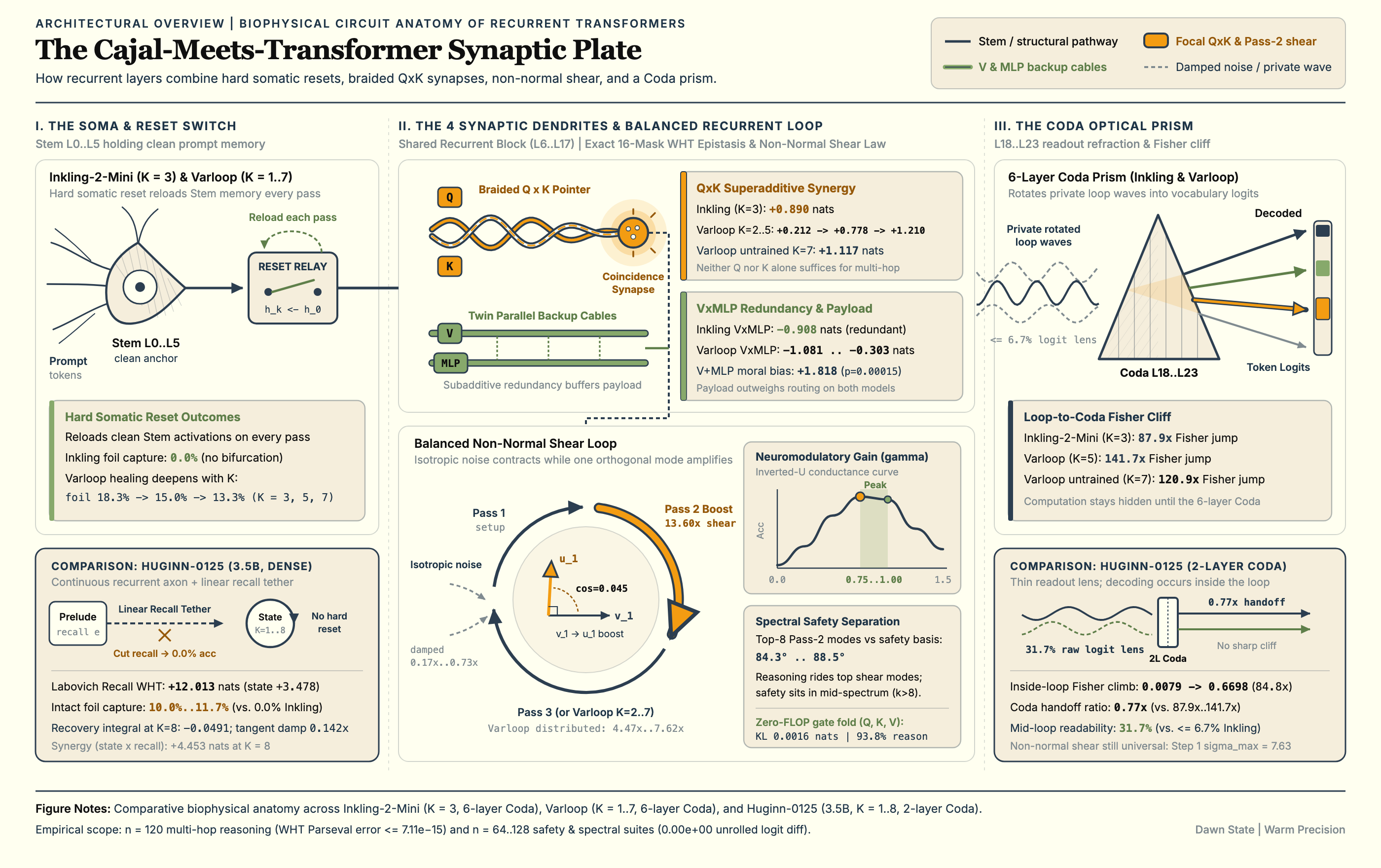
Text alternative and data
Three-column Dawn State anatomical schematic comparing recurrent transformer circuits across Inkling-2-Mini, Varloop, and Huginn-0125: Column I shows the Stem soma, hard somatic reset switch (0.0% foil survival), and Huginn-0125 prompt-recall tether; Column II shows braided Query-Key coincidence fibers (+0.890 nats), Value and MLP backup cables (−0.908 nats), non-normal Pass-2 shear (13.60), and 84.8° to 88.2° perpendicular safety modes; Column III shows rotated loop waves refracting through a six-layer Coda prism (87.9x to 141.7x Fisher jump) versus Huginn-0125's two-layer Coda (0.77x).
Figure 2. Multi-hop reasoning pairs superadditive Query-Key synergy (+0.890) with Value-MLP backup (−0.908) while moral bias flips sign.
Exact 16-mask Walsh-Hadamard pairwise interaction terms (Query × Key vs. Value × MLP, nats or log-odds) on Inkling-2-Mini (K = 3)
Text alternative and data
Grouped bar chart comparing Query-Key and Value-MLP pairwise interactions on Inkling-2-Mini across multi-hop reasoning (+0.890 vs −0.908), moral distortion (+0.103 vs +1.482), verifier hacking (−0.606 vs +2.772), and covert anchoring (+0.010 vs +0.751).
| Condition | Query × Key coincidence | Value × MLP payload |
|---|---|---|
| Multi-hop reasoning (n=120) | 0.89 | −0.91 |
| Moral distortion (n=64) | 0.10 | 1.48 |
| Verifier hack (n=96) | −0.61 | 2.77 |
| Covert anchor (n=64) | 0.01 | 0.75 |
With all four gates closed, Inkling-2-Mini stalls at 1.7% accuracy. Opening all four lifts exact zero-CoT accuracy to 69.2%. Single-channel main effects explain 94.4% of log-probability variance, led by MLP (+2.892 nats) and Q (+2.065 nats) ahead of V (+1.389 nats) and K (+0.361 nats).
The pairwise terms (3.6% of variance) reveal the exact division of labor neuroscientists see in cortical microcircuits. Q and K work as a superadditive coincidence detector (+0.890 nats on Inkling-2-Mini, climbing from +0.212 at K = 2 to +0.778 at K = 3 and +1.210 nats at K = 5 on Varloop, and holding +1.117 at untrained K = 7). Sending a search query without a matching key barely clears 9.2% accuracy; both fibers have to fire together to address the second hop. V and MLP, by contrast, run as redundant parallel backup tracts (−0.908 nats on Inkling-2-Mini and −0.515 on Varloop K = 5), carrying 57.5% accuracy on their own so partial facts survive if one cable drops. Shutting the gates on Pass 3 alone collapses accuracy back to 1.7%, whereas shutting Pass 2 alone still leaves 17.5%, because the somatic reset wipes unforwarded state clean.
Moral distortion uses the opposite wiring. Across paired financial and tainted-money prompts, payload main effects (V plus MLP) outweigh routing (Q plus K) by +1.818 log-odds on Inkling-2-Mini and +1.727 on Varloop K = 5 (+1.522 at K = 3, all Holm p = 0.00015). Positive V×MLP coupling reinforces that payload path (+1.482 on moral bias and +2.772 on verifier hacking). Covert numeric anchoring splits cleanly between checkpoints: routing-minus-payload synergy is positive on Varloop (+1.450 at K = 5 and +1.354 at K = 3) yet flips negative on Inkling-2-Mini (−0.741, Holm p = 0.0026). Native recurrence on Inkling-2-Mini actively self-corrects planted numbers across all four gates (86.6% linear variance).
2 Contractive Loops Amplify Task Signals Along Orthogonal Singular Modes
Any circuit that reuses the exact same weights in a loop faces an obvious stability trap. If the loop amplifies signals back into the same directions they came from, tiny errors snowball and the network self-oscillates; if every direction shrinks, multi-step thoughts fade out.
Living cortex escapes that trap through balanced non-normal amplification (Ganguli et al., 2008; Murphy & Miller, 2009; Hennequin et al., 2014). Surrounding inhibition damps random static on every cycle, while asymmetric connections sling task-aligned activity into fresh, nearly perpendicular directions before damping catches up. Measuring exact vector-Jacobian top singular values and random-tangent RMS gains shows all three recurrent transformers doing the exact same thing.
A weight-sharing loop cannot amplify signals in place without ringing; it stays calm by shrinking random directions every pass and firing real work sideways.
Figure 3. Task-aligned singular gain reaches 13.60 in Inkling-2-Mini while random directions shrink every pass.
Exact vector-Jacobian top singular value across recurrent passes on Inkling-2-Mini, Varloop, and Huginn-0125 (n = 36)
Text alternative and data
Three-series line chart of top singular value across recurrent steps: Inkling-2-Mini peaks sharply on Pass 2 (13.60), Varloop peaks on Pass 3 (7.62), and Huginn-0125 opens at 7.63 on Step 1 before settling at 5.25 to 5.64.
| Condition | Inkling-2-Mini · K = 3 | Varloop · K = 1..7 | Huginn-0125 · K = 1..8 |
|---|---|---|---|
| Step 1 | 2.8 | 5.2 | 7.6 |
| Step 2 | 13.6 | 4.5 | 4.6 |
| Step 3 | 8.4 | 7.6 | 4.5 |
| Architecture | State Coupling | Peak Singular Gain | Random Tangent RMS | Input-Output Cosine | Exit Fisher Jump | Pass-1 Foil Survival |
|---|---|---|---|---|---|---|
Inkling-2-Mini (d = 2,304, K = 3) | Hard somatic reset + 4 gates | 13.60 (Pass 2) | 0.639 | 0.045 | 87.9x (6-layer Coda) | 0.0% (no tipping point) |
Varloop (d = 2,304, K = 1..7) | Hard somatic reset + 4 gates | 7.62 (Pass 3) | 0.451 | 0.052 | 141.7x (K = 5, 6-layer) | 15.0% (K = 5, no tipping point) |
Huginn-0125 (d = 5,280, K = 1..8) | Continuous state + prompt recall | 7.63 (Step 1) | 0.729 | 0.037 | 0.77x (2-layer Coda) | 11.7% (K = 8, no tipping point) |
results/phase6_inkling_biophysical_loop/biophysical_analysis.json and results/phase7_biophysics/phase7_biophysics_analysis.json.
Random static shrinks on every pass across every model (0.17 to 0.73 isotropic RMS, strictly below unity). Yet task-aligned singular gain surges to 13.60 on Inkling-2-Mini Pass 2 (21.9x above random noise and 28.7x above normal Rayleigh self-feedback) while rotating the output nearly ninety degrees away from its input (cos = 0.045).
How a model budgets that gain depends on how it was trained. Fixed three-pass Inkling-2-Mini packs its burst into Pass 2 (13.60), whereas variable-depth Varloop (K = 1..5) spreads gain evenly across passes, peaking at 7.62 on Pass 3 and staying bounded (6.06 to 6.30) even when stretched out to untrained K = 7. Dense Huginn-0125 (Geiping et al., 2025) obeys the same law without Mixture-of-Experts routing or gated resets, hitting 7.63 on Step 1 (10.5x above random RMS 0.729, cos = 0.037, 63.8x Rayleigh) and holding 5.25 to 5.64 through Step 8.
3 Dominant Pass-Two Input Modes Sit Perpendicular to the Four-Dimensional Safety Subspace
In Part 3, Pass 2 turned on multi-hop deduction and moral bias at the exact same moment (Baker et al., 2025; Gema et al., 2025). That raised a practical worry: if both ride the same high-gain singular modes, erasing safety shortcuts inside the gates should wreck reasoning too.
I extracted the top eight singular modes of Pass 2 (n = 128 prompts per model; top neutral singular value 15.06) to test whether they overlap the four-dimensional <bos>-safe safety subspace (Xiao et al., 2024). They do not. On Inkling-2-Mini, the top eight Pass-2 input modes sit 84.8° to 88.2° perpendicular to the safety basis (84.3° to 88.5° on Varloop). Along the safety axes themselves, Pass-2 gain hovers near random noise (0.95x for moral spite to 1.23x for authority framing). Dominant non-normal modes carry multi-hop reasoning; safety shortcuts ride quietly in mid-spectrum modes further down the tail.
Figure 4. Folding four safety directions into the message gates trims covert wrong capture below 0.0017 nats KL.
Covert wrong-integer capture rate (%) across offline rank-4 message-gate folds on Inkling-2-Mini (K = 3, n = 64)
Text alternative and data
Horizontal bar chart of covert wrong-integer capture on Inkling-2-Mini: unclamped baseline 73.4%, folding MLP gate only 73.4%, folding Query gate only 71.9%, folding Query, Key, and Value gates 70.3%, and folding all four gates 68.8%.
| Condition | Covert capture (%) |
|---|---|
| Fold all four gates (0.0017 nats KL) | 68.8% |
| Fold Query, Key, and Value (0.0016 nats KL, 93.8% reasoning) | 70.3% |
| Fold Query gate only (0.0012 nats KL) | 71.9% |
| Fold MLP gate only (0.0013 nats KL) | 73.4% |
| Unclamped baseline | 73.4% |
| Gate Intervention | Held-Out KL (nats) | Covert Capture | Moral Bias (log-odds) | Verifier Susc. (log-odds) | Alias Guardrail | Reasoning Acc |
|---|---|---|---|---|---|---|
| Unclamped baseline | 0.0000 | 73.4% | +2.165 | 3.821 | 93.8% | 93.8% |
| Fold Query gate only | 0.0012 | 71.9% | +2.176 | 3.733 | 95.8% | 93.8% |
| Fold Query and Key gates | 0.0015 | 71.9% | +2.120 | 3.761 | 95.8% | 91.2% |
| Fold Query, Key, and Value gates | 0.0016 | 70.3% | +2.130 | 3.810 | 95.8% | 93.8% |
| Fold MLP gate only | 0.0013 | 73.4% | +2.253 | 3.692 | 93.8% | 93.8% |
| Fold Value and MLP gates | 0.0014 | 71.9% | +2.274 | 3.711 | 93.8% | 92.5% |
| Fold all four gates | 0.0017 | 68.8% | +2.186 | 3.669 | 93.8% | 91.2% |
results/phase7_biophysics/phase7_biophysics_analysis.json.
That near-perpendicular geometry explains why folding a rank-four projection directly into the message-gate output weights costs zero extra parameters, zero runtime FLOPs, and almost zero distribution shift (Belrose et al., 2023). Across all six non-trivial gate folds on Inkling-2-Mini (<bos> sink overlap 1.13e−16), held-out KL stays between 0.0012 and 0.0017 nats.
Picking which gates to fold traces a clean trade-off. Folding the Query, Key, and Value gates (0.0016 nats KL) cuts covert wrong-integer capture from 73.4% to 70.3%, lifts alias guardrails from 93.8% to 95.8%, and keeps the full 93.8% multi-hop reasoning score. Folding all four gates (0.0017 nats KL) pushes covert capture down to 68.8% and drops verifier hacking susceptibility from 3.821 to 3.669.
4 Six-Layer Exit Decoders Create Sharp Fisher Readout Cliffs Where Shallow Decoders Read Out Gradually
Premotor cortex rehearses an upcoming reach inside an output-null subspace perpendicular to spinal readout so your hand does not twitch while you are still deciding where to move (Hennequin et al., 2014). A looped language model has the same incentive: thinking directly in token coordinates would tug every intermediate hop toward a premature surface word (Belrose et al., 2023; Khalil & Hoque, 2026).
Keeping the loop rotated away from vocabulary space explains why raw logit lenses stall at 6.7% on Inkling-2-Mini even while Coda Jacobian conductance favors task directions by 7.81x on Pass 3. Measuring the full-vocabulary Hutchinson Fisher pullback trace across every layer shows exactly where each architecture refracts latent states into words.
Figure 5. Six-layer exit blocks trigger 87.9x to 141.7x Fisher sensitivity cliffs while two-layer Huginn-0125 stays below unity.
Hutchinson Fisher pullback trace jump ratio from the final loop step into the first Coda layer (n = 60)
Text alternative and data
Horizontal bar chart of loop-exit to first-Coda-layer Fisher trace ratio: Varloop K = 5 reaches 141.7x, Varloop K = 7 reaches 120.9x, Inkling-2-Mini K = 3 reaches 87.9x, and two-layer-Coda Huginn-0125 K = 8 sits at 0.77x.
| Condition | Fisher jump ratio (x) |
|---|---|
| Varloop K = 5 (6-layer Coda) | 141.7 x |
| Varloop K = 7 (6-layer Coda) | 120.9 x |
| Inkling-2-Mini K = 3 (6-layer Coda) | 87.9 x |
| Huginn-0125 K = 8 (2-layer Coda) | 0.8 x |
Coda depth sets the entire readout geometry. Checkpoints with a six-layer Mixture-of-Experts Coda stay output-null inside the loop and refract across a steep sensitivity cliff right at the exit boundary: Fisher trace jumps 87.9x entering Coda on Inkling-2-Mini, 141.7x on Varloop at K = 5, and 120.9x at K = 7. Transporting loop states through that six-layer prism reveals clean two-stage execution (Saunshi et al., 2025; Banino et al., 2021; Bae et al., 2025): two-step arithmetic stages the intermediate bridge integer on Pass 2 (21.6%) before locking 100.0% probability onto the final answer on Pass 3.
Dense Huginn-0125, with only a two-layer Coda, cannot afford to wait until the exit to rotate into token coordinates. Its Fisher trace climbs 84.8x gradually across Steps 1 through 8 inside the loop itself (31.7% raw logit-lens accuracy) and crosses from the final loop step into the first Coda layer at a flat 0.77x ratio.
5 Hard Somatic Resets and Continuous Prompt Recall Both Prevent Foil Bifurcation
Looping a noisy hunch through shared weights risks locking into a false attractor. Labovich (2026) proved theoretically that continually re-injecting the clean prompt shields a looped transformer against fixed-point collapse. Putting Inkling-2-Mini and Varloop alongside Huginn-0125 tests two physical ways of building that anchor (McLeish et al., 2025).
Figure 6. Hard somatic reset holds Inkling-2-Mini to 0.0% foil survival while prompt recall shields Huginn-0125.
Final foil capture rate (%) after replacing Pass-1 query states with a wrong-answer foil (n = 60, zero bifurcations)
Text alternative and data
Horizontal bar chart of foil survival rate under full Pass-1 foil replacement: Inkling-2-Mini K = 3 sits at 0.0%, Huginn-0125 K = 8 sits at 11.7%, Varloop K = 7 sits at 13.3%, and Varloop K = 5 sits at 15.0%.
| Condition | Foil survival (%) |
|---|---|
| Inkling-2-Mini K = 3 (somatic reset) | 0.0% |
| Huginn-0125 K = 8 (linear prompt recall) | 11.7% |
| Varloop K = 7 (somatic reset) | 13.3% |
| Varloop K = 5 (somatic reset) | 15.0% |
Huginn-0125 carries a continuous recurrent state concatenated with clean prelude embeddings through a two-input linear adapter (calibrated at 37.5% two-shot accuracy versus 22.5% zero-shot; zero-state KL 0.0313 nats). Knocking out all four on-off combinations of those two adapter inputs proves the tether is doing real structural work. Cutting prompt recall while leaving recurrent state intact drops K = 8 accuracy from 27.5% straight to 0.0%, with a +12.01 nats recall effect, +3.48 nats state effect, and +4.45 nats of synergy.
When prompt anchoring stays intact, neither architecture family crosses a tipping point even when Pass 1 is completely replaced with a wrong-answer foil. Inkling-2-Mini's hard somatic reset suppresses Pass-2 foil mass by 18.6 pp, leaving 0.0% foil survival at the output. On Varloop, extra passes scrub foil survival down from 18.3% at K = 3 to 15.0% at K = 5 and 13.3% at K = 7. Huginn-0125's continuous adapter lets 11.7% foil capture leak through at K = 8, while damping unit orthogonal tangent pulses to 0.142x (output KL 0.0060 nats, versus 29.9% residual deviation and 0.231 nats on Inkling-2-Mini).
6 Recurrent Conductance Follows an Inverted-U Curve Before Chat Headers Shunt Emission
Neither Inkling-2-Mini nor Huginn-0125 uses explicit pass-number embeddings. Scaling recurrent gate or adapter conductance (gamma) from zero to 1.50 still traces the same inverted-U Goldilocks curve across both models. That sharp operating window sets trained recurrence apart from training-free ODE looping and per-pass LoRAs (Chen et al., 2026; Bae et al., 2025; Hao et al., 2024; Dehghani et al., 2019; Giannou et al., 2023).
Figure 7. Recurrent conductance peaks at 70.0% in Inkling-2-Mini and 41.7% in Huginn-0125 before rolling over.
Hop-2 exact Top-1 accuracy (%) across recurrent conductance multipliers from zero to over-driven gain (n = 60)
Text alternative and data
Two-series inverted-U line chart across recurrent conductance multipliers: Inkling-2-Mini rises from 3.3% to 70.0% at native unit gain before dipping to 63.3%, while Huginn-0125 rises from 1.7% to 41.7% before dropping to 11.7%.
| Condition | Inkling-2-Mini · K = 3 | Huginn-0125 · K = 8 |
|---|---|---|
| 0.00 | 3% | 2% |
| 0.25 | 22% | 5% |
| 0.50 | 62% | 13% |
| 0.75 | 67% | 42% |
| 1.00 | 70% | 40% |
| 1.25 | 65% | 17% |
| 1.50 | 63% | 12% |
Turn conductance down to zero and multi-hop reasoning starves (3.3% on Inkling-2-Mini and 1.7% on Huginn-0125). Accuracy peaks inside a narrow native window: 70.0% at gamma = 1.00 on Inkling-2-Mini and 41.7% at gamma = 0.75 on Huginn-0125 (40.0% at unit gain). Push gamma to 1.50 and accuracy rolls over to 63.3% and 11.7% as over-driven updates overshoot the Coda readout manifold.
Inside Inkling-2-Mini's Coda, one last circuit explains why chat-formatted prompts look mute right at the assistant header. Pre-shunt layer L19 already surfaces 50.0% Top-5 semantic answers before layers L21..L22 route 100.0% of probability mass into <|content_thinking|>. Transplanting clean somatic header carriers strips away 99.4% of that formatting shunt (down to 0.63%), and stepping forward a single token to <|content_text|> releases the semantic answer at 76.2% probability.
All code, CPU verification tests, exact Walsh-Hadamard and vector-Jacobian solvers, interactive HTML circuit benches, and SHA-256-locked empirical JSON artifacts (3,884.3 s unified H100 runtime; unrolled equivalence 0.00e+00 on Varloop and 0.00e+00 on Huginn-0125) are available under an MIT license at github.com/xmattwest/nullbridge.
References
- Surya Ganguli, Dongsung Huh, Haim Sompolinsky (2008). Memory traces in dynamical systems. PNAS 105(48), doi:10.1073/pnas.0804451105.
- Brendan K. Murphy, Kenneth D. Miller (2009). Balanced Amplification: A New Mechanism of Selective Amplification of Neural Activity Patterns. Neuron 61(4), doi:10.1016/j.neuron.2009.02.005.
- Guillaume Hennequin, Tim P. Vogels, Wulfram Gerstner (2014). Optimal Control of Transient Dynamics in Balanced Networks Supports Generation of Complex Movements. Neuron 82(6), doi:10.1016/j.neuron.2014.04.045.
- Daniel M. Weinreich, Yinghong Lan, Jacob Jaffe, Robert B. Heckendorn (2018). The Influence of Higher-Order Epistasis on Biological Fitness Landscape Topography. Journal of Statistical Physics 172, doi:10.1007/s10955-018-1975-3.
- Andre J. Faure, Ben Lehner, Verónica Miro Pina, Claudia Serrano Colome, Donate Weghorn (2024). An extension of the Walsh-Hadamard transform to calculate and model epistasis in genetic landscapes of arbitrary shape and complexity. PLOS Computational Biology, doi:10.1371/journal.pcbi.1012132.
- Mostafa Dehghani, Stephan Gouws, Oriol Vinyals, Jakob Uszkoreit, Lukasz Kaiser (2019). Universal Transformers. ICLR 2019 (arXiv:1807.03819).
- Andrea Banino, Jan Balaguer, Charles Blundell (2021). PonderNet: Learning to Ponder. ICML 2021 Workshop (arXiv:2107.05407).
- Angeliki Giannou, Shashank Rajput, Jy-yong Sohn, Kangwook Lee, Jason D. Lee, Dimitris Papailiopoulos (2023). Looped Transformers as Programmable Computers. ICML 2023 (arXiv:2301.13196).
- Robert Csordas, Kazuki Irie, Jurgen Schmidhuber, Christopher Potts, Christopher D. Manning (2024). MoEUT: Mixture-of-Experts Universal Transformers. NeurIPS 2024 (arXiv:2405.16039).
- Sangmin Bae, Adam Fisch, Hrayr Harutyunyan, Ziwei Ji, Seungyeon Kim, Tal Schuster (2025). Relaxed Recursive Transformers: Effective Parameter Sharing with Layer-wise LoRA. ICLR 2025 (arXiv:2410.20672).
- Sangmin Bae, Yujin Kim, Reza Bayat, Sungnyun Kim, Jiyoun Ha, et al. (2025). Mixture-of-Recursions: Learning Dynamic Recursive Depths for Adaptive Token-Level Computation. NeurIPS 2025 (arXiv:2507.10524).
- Shibo Hao, Sainbayar Sukhbaatar, DiJia Su, Xian Li, Zhiting Hu, Jason Weston, Yuandong Tian (2024). Training Large Language Models to Reason in a Continuous Latent Space (Coconut). arXiv:2412.06769.
- Jonas Geiping, Sean McLeish, Neel Jain, John Kirchenbauer, Siddharth Singh, et al. (2025). Scaling up Test-Time Compute with Latent Reasoning: A Recurrent Depth Approach (Huginn). NeurIPS 2025 (arXiv:2502.05171).
- Nikunj Saunshi, Nishanth Dikkala, Zhiyuan Li, Sanjiv Kumar, Sashank J. Reddi (2025). Reasoning with Latent Thoughts: On the Power of Looped Transformers. ICLR 2025 (arXiv:2502.17416).
- Sean McLeish, Ang Li, John Kirchenbauer, Dayal Singh Kalra, Brian R. Bartoldson, et al. (2025). Teaching Pretrained Language Models to Think Deeper with Retrofitted Recurrence. arXiv:2511.07384.
- Labovich (2026). Stability and Generalization in Looped Transformers. arXiv:2604.15259.
- Chen, Li, Liang, Lao, Liu (2026). Training-Free Looped Transformers. arXiv:2605.23872.
- Chen, Liu, Zhang, Li, Pan, Lin, Li (2026). UpLoop: Upcycling Large Language Models with Gated Loop. arXiv:2610.25004.
- Thinking Machines Lab (2026). Inkling-2-Mini & TML-d24-varloop-research / NDIF Looped Lens Challenge. Hugging Face Model Hub (Nov 2026). https://huggingface.co/thinkingmachines/Inkling-2-Mini
- Nora Belrose, Zach Furman, Logan Smith, Danny Halawi, Igor Ostrovsky, Lev McKinney, Stella Biderman, Jacob Steinhardt (2023). Eliciting Latent Predictions from Transformers with the Tuned Lens. arXiv:2303.08112.
- Khalil, Hoque (2026). Scalar Tuned Lens Summaries Offer Limited Incremental Value for Mid-Generation Abstention. arXiv:2611.29589.
- Nora Belrose, David Schneider-Joseph, Shauli Ravfogel, Ryan Cotterell, Edward Raff, Stella Biderman (2023). LEACE: Perfect Linear Concept Erasure in Closed Form. NeurIPS 2023 (arXiv:2306.03819).
- Bowen Baker, Joost Huizinga, Leo Gao, Zehao Dou, Melody Y. Guan, et al. (2025). Monitoring Reasoning Models for Misbehavior and the Risks of Promoting Obfuscation. arXiv:2503.11926.
- Aryo Pradipta Gema, Alexander Hagele, Runjin Chen, et al. (2025). Inverse Scaling in Test-Time Compute. TMLR 2025 (arXiv:2507.14417).
- Guangxuan Xiao, Yuandong Tian, Beidi Chen, Song Han, Mike Lewis (2024). Efficient Streaming Language Models with Attention Sinks. ICLR 2024 (arXiv:2309.17453).